Sewer Line Root Removal in Broward County
Sewer line root removal cuts and flushes the root mass out of the line, usually by hydro jetting with a root nozzle. Because roots can only enter through an existing crack or failed joint, the removal is half the job — the opening they came through is the other half.
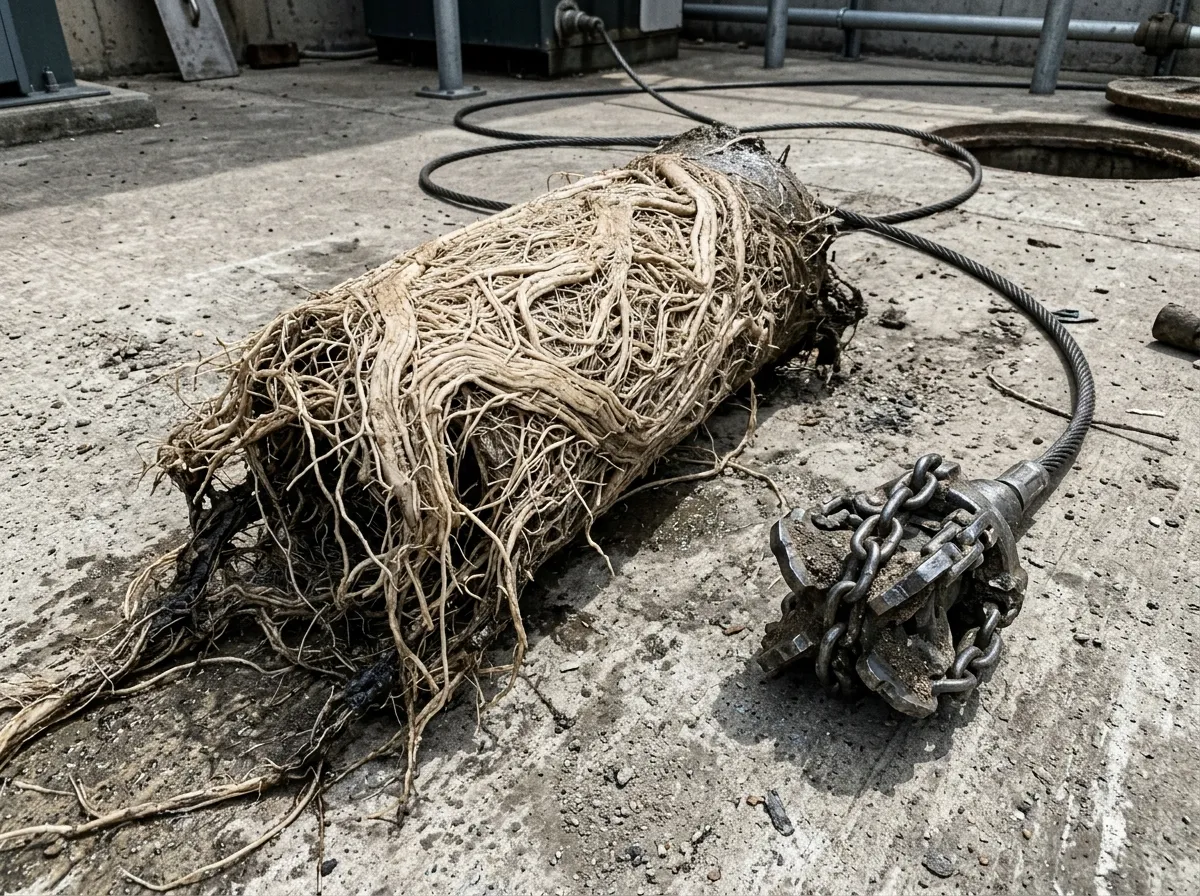
Root removal is straightforward work with one uncomfortable implication attached, and the implication is the part worth understanding before paying for it.
Roots prove a defect exists
Roots do not bore through cast iron or PVC. They follow moisture, and a sewer line only releases moisture where it is already open. A widely upvoted comment states it plainly: “Definitely roots. They can only get inside from a break in the pipe.”
So finding roots is finding a crack, a failed joint, or a corroded section. Removing the roots restores flow; the opening stays, and roots return to it.
In Broward the usual sources are ficus, live oak, black olive and palms, all with aggressive lateral roots, planted along property lines where the lateral tends to run.
How removal is done
- Hydro jetting with a root nozzle — cuts and flushes the mass out, the most thorough option
- Mechanical cutting with a rotating root-cutter head on a cable
- Foaming root herbicide — kills root tissue in contact with the foam, typically holding a year or so and requiring repetition
- Camera inspection immediately afterward — the only way to see the entry point now the mat is gone
The camera step is where the value is. With the roots cleared, the opening they used becomes visible and locatable, and the repair can be scoped.
Then the actual decision
| Finding | Options |
|---|---|
| Roots at one joint, pipe round and graded | Sectional liner, or excavate and re-couple |
| Roots at several joints, pipe otherwise sound | Full-length lining |
| Roots plus an offset joint | Excavation or pipe bursting — a liner cannot cure across a step |
| Roots plus a belly | Replacement of the affected run |
| Roots plus channelled cast iron | Replacement |
The criticism of lining, and what it gets right
The strongest objection to lining a root-damaged line comes from a plumber: “If cast iron did not stop those roots what makes you think a liner will?”
A cured liner is jointless, so along the lined run the entry points stop existing. But the objection is right about partial coverage — a liner covering thirty of fifty feet leaves twenty feet of original joints, and one that stops short of the connection at the main leaves the most root-prone joint in the system untouched.
Ask what length is being lined, where it starts and terminates, what happens at the connection, and whether the warranty covers the whole line.
The pattern to avoid
An annual root clearing on the same line is not maintenance. It is a defect being managed indefinitely at a few hundred dollars a year while the root wedged in the crack levers it steadily wider — which eventually admits soil, not just roots, and turns a repairable joint into a section that has washed out beneath the slab.
“Roots tell us where the break is. We jet it, scope it, and mark the depth and distance, so the homeowner knows what is actually being repaired.”
If roots have been cleared from your line before, request a free quote.
Related services
- Tree Roots in a Sewer Line: Why They Get In and What Stops ThemTree roots cannot penetrate sound sewer pipe. They enter through a crack, a failed joint…
- Hydro Jetting for Broward County Sewer LinesHydro jetting drives water at high pressure through a rearward-facing nozzle that scours…
- CIPP Pipe Lining: How Cured-in-Place Lining Works and When It Does NotCIPP lining pulls a resin-saturated felt sleeve into an existing sewer pipe, inflates it…
- Broken Sewer Line: The Signs, and What They Look Like in FloridaA broken sewer line shows itself through repeat backups, a persistent sewer smell at flo…